
Tom Maoli
The Collection
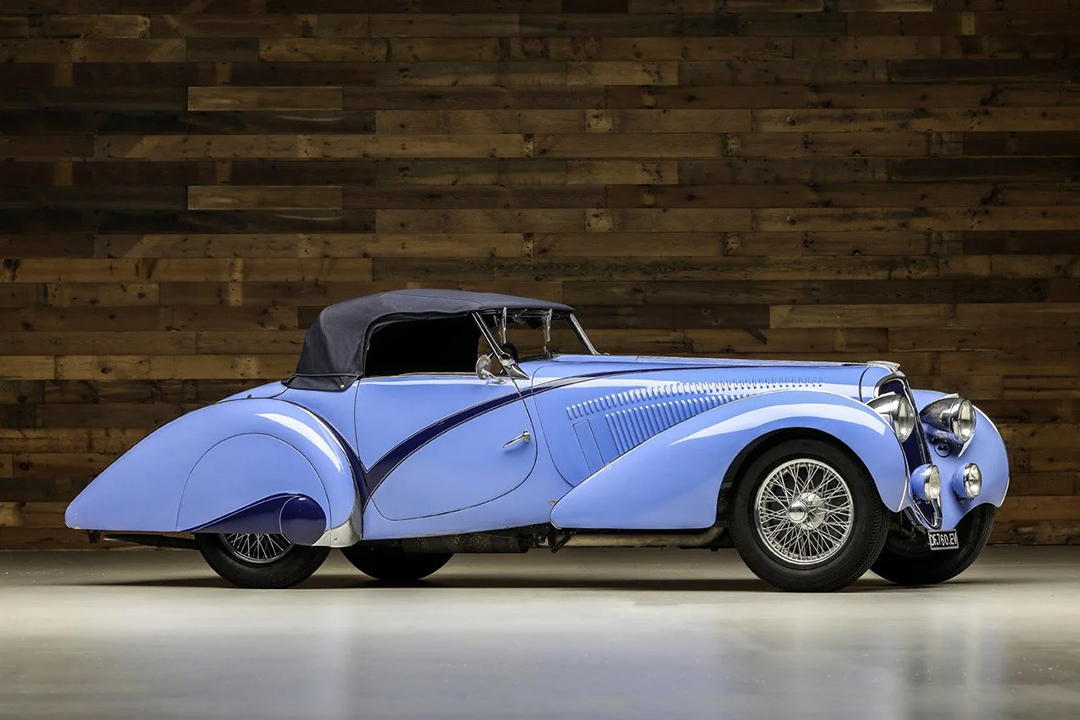
1936 Delahaye 136M Competition Court Cabriolet
-
Coachwork by Figoni et Falaschi
- Chassis No. 46837
-
Body No. 572
This extraordinary 1936 Delahaye 135 Competition Court is one of only six coupes bodied by the legendary French coachbuilder Figoni et Falaschi that year. Built on the ultra-rare 2.7-meter short-wheelbase chassis, designed to satisfy homologation requirements for racing, these examples were the pinnacle of French automotive design and performance of the era. Of the six produced, this particular car is unique — the only one originally configured as a “faux cabriolet” with an uncommon three-seat arrangement (two front seats and a single rear seat), as documented in the Figoni register.
1936 Packard 1407 Twelve Sport Dual Cowl Phaeton
- Body by Dietrich
- Vehicle No. 921-205
- Chassis No. 904502
Few automobiles define American luxury of the 1930s like the Packard Twelve, and among them, none is more dramatic than the dual-cowl Sport Phaeton. Built in extremely limited numbers, just five were produced in 1936 on the mighty 144-inch-wheelbase Twelve chassis. This example, chassis 921-205, is believed to be the final dual-cowl phaeton ever built by Packard, delivered late in the model year by the Park Avenue dealership in New York.

1938 Talbot-Lago T150 C Lago Special
-
Chassis No.10797
-
Engine No. 13609
Few cars capture the spirit of prewar French design and performance quite like the Talbot-Lago T150 C. And among the handful of surviving examples, none rival the singular presence of chassis 90034 – the only long-wheelbase “Teardrop” coupe built by legendary coachbuilder Figoni et Falaschi in their most dramatic, exposed-wheel configuration. Talbot-Lago’s resurgence in the mid-1930s was led by the bold vision of Anthony Lago, an Italian-born engineer and entrepreneur who transformed the struggling marque into a powerhouse of style and speed. With a newly developed 4.0-liter straight-six engine, a pre-selector gearbox, and a focus on racing and design innovation, Talbot-Lago models quickly gained notoriety for their sophistication and performance.
